|
SAN ANTONIO SPURS, on behalf of the People of San Antonio and all Persons Wearing Silver and Black,
Plaintiff,
v.
NEW YORK KNICKS; CERTAIN NEW YORK KNICKS FANS OF NEW YORK CITY; JOHN DOES 1–99, being unknown persons who treated silver and black as probable cause; NATIONAL BASKETBALL ASSOCIATION; ADAM SILVER, in his official capacity as Commissioner of the National Basketball Association; and OFFICIAL NBA REFEREES DOES 1–3,
Defendants.
|
Case No.1:26-cv-00613-WJH |
This matter is before the Court sua sponte following postgame disorder, league inaction, and an officiating spectacle arising during Games Three, Four, and Five of the NBA Finals between the San Antonio Spurs and the New York Knicks.
The Court writes from a narrow but proper perspective: that of a San Antonio Spurs fan, an NBA fan, and a citizen of basketball civilization disgusted by what occurred in New York, bewildered by what was tolerated on the floor, and unimpressed by the silence from the league office.
The question presented is not whether Knicks fans may celebrate. They may.
The question is not whether Madison Square Garden may be hostile. It should be.
The question is not whether New York may be loud, theatrical, self-important, emotionally combustible, and convinced that every national broadcast should begin with a tribute to its own relevance. It may, and historically has.
The question is whether certain Knicks fans, after finally witnessing meaningful basketball in June, mistook temporary relevance for a license to harass visiting fans, menace opposing supporters, swarm team hotels, throw objects at players, and transform both victory and defeat into public evidence of fanbase malpractice.
The further question is whether the NBA Commissioner and the officiating crews presiding over this Finals performed their duties with the necessary seriousness, neutrality, and competence, or whether they allowed the series to devolve into an absolute officiating and disciplinary shitshow.
For the reasons set forth below, the Court finds that they did the latter.
I. BACKGROUND
Game Three was played at Madison Square Garden on June 8, 2026. The San Antonio Spurs defeated the New York Knicks, 115-111. It was a legitimate Finals win on the road, earned in the building New York insists is the spiritual capital of basketball.
A serious fanbase would have absorbed the loss, complained about officiating, screamed about rotations, blamed one missed box-out, and returned for Game Four.
Certain Knicks fans instead responded as though the sight of a Spurs jersey on Manhattan pavement constituted an emergency under local law.
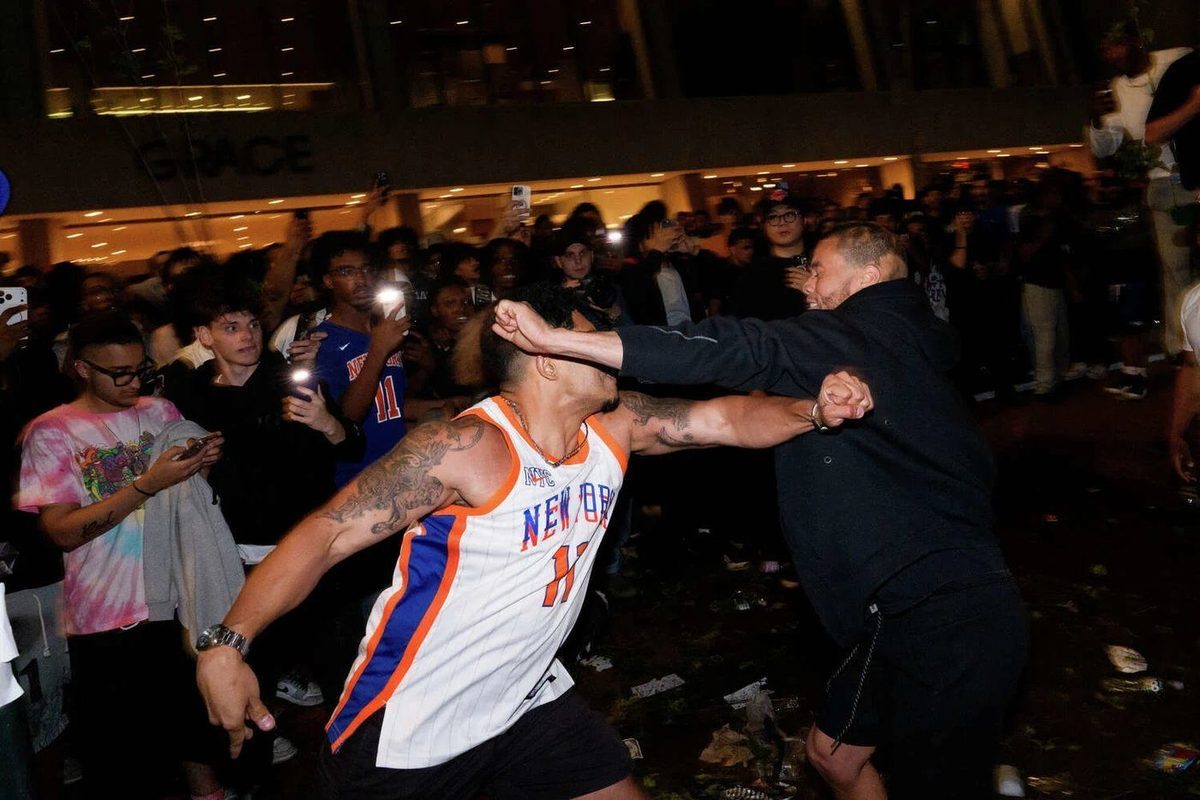
Reports following Game Three described a 39-year-old San Antonio fan walking back to his hotel when a group surrounded him, punched and kicked him, and forcibly removed his Spurs jersey. That is not ordinary postgame hostility. That is not “passion.” That is not “New York being New York.” That is mob conduct wearing team colors.
The Court pauses here to state the obvious: a Spurs jersey is not contraband. A Tim Duncan jersey is not probable cause. A visiting fan walking back to his hotel is not an invading army. And a fanbase that needs a group beating to deal with one man in silver and black has already lost the argument.
Game Four made the record worse.
On June 10, 2026, the Knicks defeated the Spurs 107-106 after erasing a 29-point deficit, the largest comeback in NBA Finals history. The Court, despite its San Antonio sympathies, acknowledges the basketball fact: it was a remarkable comeback. It was painful. It was historic. It was the kind of game a winning fanbase should celebrate with joy, relief, and maybe one night of obnoxious but lawful shouting.
Instead, the postgame scene reportedly included jeering fans outside the Spurs’ hotel and at least one egg thrown in the direction of Victor Wembanyama as he entered the building with security.
The Court finds this uniquely aggravating.
Throwing objects after a loss is disgraceful.
Throwing objects after a win is pathology.
The Court further finds that the misconduct was not limited to ordinary jersey-stripping, heckling, or customary postgame unpleasantness. The record reflects something more serious: Spurs fans in silver and black were treated not merely as opposing supporters, but as fair game for mob-style intimidation.
New York did not merely boo the Spurs.
New York did not merely heckle the Spurs.
New York did not merely dislike the Spurs.
Certain Knicks fans appeared to treat silver and black as probable cause.
That distinction matters.
II. JURISDICTION AND VENUE
This Court exercises satirical jurisdiction pursuant to the inherent authority of TheSportsJudge.com to adjudicate matters involving sports misconduct, fan delusion, public embarrassment, referee failure, league silence, and conduct prejudicial to the dignity of the National Basketball Association.
Venue is proper in this District because the conduct occurred in and around New York City, a municipality that has long held itself out as the capital of culture, toughness, sophistication, media importance, unsolicited opinions, and $27 beverages served in plastic cups.
Venue is further proper as to the NBA, Commissioner Silver, and Official NBA Referees Does 1-3 because the misconduct occurred under the league’s watch, on the league’s stage, during the league’s premier event, while the league’s officials appeared to mistake crowd management and basic whistle discipline for optional electives.
Having made the NBA Finals its showcase, the league may not now disclaim responsibility when the showcase begins to look like a municipal stress test with a basketball attached.
III. LEGAL STANDARD
The applicable standard is whether a reasonable NBA fan, familiar with ordinary rivalry and capable of distinguishing passion from disorder, would find the conduct at issue disgraceful.
The Court applies the settled principles of basketball common law.
First, opposing fans may attend games and walk through public streets without being treated as hostile combatants.
Second, jerseys are not fighting words.
Third, a visiting fan’s decision to support San Antonio is not consent to assault, harassment, intimidation, theft, or public humiliation.
Fourth, professional athletes are not fair targets for thrown objects because a crowd cannot regulate its emotions.
Fifth, winning a basketball game should reduce the urge to behave like a defendant.
Sixth, “that’s just New York” is not a defense. It is an admission.
Seventh, a 7-foot-4 generational player is not an open invitation for holding, grabbing, shoving, leaning, hacking, riding, and then pretending the laws of physics are merely “playoff basketball.”
Eighth, front-row fans are spectators, not assistant defensive coordinators.
Ninth, the Commissioner of the National Basketball Association is not a decorative office.
Tenth, silence in the face of escalating fan misconduct is not leadership. It is risk management by disappearing act.
These principles are not new. The Reporter of Fan Misconduct is regrettably thick.
In Indiana Pacers v. Detroit Pistons, 97-82, 0 Fan Restraint 45.9 (Palace of Auburn Hills Nov. 19, 2004) (“Malice at the Palace”), the Court of Public Memory held that the boundary between fan and player must remain more sacred than a beer cup hurled from the stands. That precedent stands for the rule that when fans inject themselves into the contest, the sport itself loses jurisdiction over sanity.
In Minnesota Vikings v. Philadelphia Eagles, 24-17, 1 Coal & Battery 15 (Franklin Field Dec. 15, 1968) (“The Birdshit Stole Christmas”), the tribunal of American sports shame held that a crowd capable of pelting Santa Claus with snowballs is presumed hostile to joy until rebutted by clear and convincing evidence. That case established the Santa Claus Rule: harmless symbols are not fair targets merely because the home crowd is miserable.
In Dallas Cowboys v. Philadelphia Eagles, 10-13, 88 Stretcher Rep. 0 (Veterans Stadium Oct. 10, 1999) (“City of Brotherly Shove”), the Court recognized the grim doctrine that cheering a career-ending injury is not rivalry, but evidence of civic rot. That precedent remains controlling for the proposition that hatred of an opponent does not suspend basic decency.
Measured against those authorities, the present matter is not an isolated failure. It is the New York chapter in the same old book: fans confusing identity with immunity, league leadership confusing silence with neutrality, and referees confusing swallowed whistles with judicial restraint.
IV. DISCUSSION
A. Game Three Established the Pattern.
The Court begins with Game Three because that is where the misconduct moved from ordinary hostility to something uglier.
The Spurs came into Madison Square Garden and won. That is sports. That is competition. That is what the NBA Finals are supposed to produce: tension, pressure, noise, heartbreak, and excellence.
But certain Knicks fans apparently could not process a visiting fanbase celebrating a road win. Instead of directing their frustration toward the scoreboard, their team’s late-game execution, or the cold reality that Victor Wembanyama is not going away, they directed it toward Spurs fans.
That choice matters.
A fan wearing a Spurs jersey is not responsible for the Knicks losing Game Three. He did not miss the defensive rotation. He did not fail to close the game. He did not personally import five championship banners from San Antonio and hang them over New York’s unresolved basketball trauma.
He wore a jersey.
That was enough for certain New Yorkers to treat him like evidence of a crime.
The Court finds that conduct contemptible.
B. The Mob Attack Upon a Spurs Fan Was Basketball Desecration.
The reported attack on a Spurs fan after Game Three included the surrounding of the victim, punches, kicks, and the forcible removal of his jersey.
The Court regards this as more than ordinary misconduct. It is symbolic.
A jersey is not merely fabric. It is identity, allegiance, memory, and record. A Spurs jersey represents an organization built on discipline, development, international scouting, selflessness, and the quiet destruction of louder teams.
To rip a Spurs jersey from a fan is to confess insecurity before the entire basketball world.
It says: “Our city is too fragile to tolerate your colors.”
It says: “Our fandom cannot survive your presence.”
It says: “We are not celebrating basketball; we are policing territory.”
To surround, punch, kick, and strip that fan of his jersey says something even worse.
It says the mob did not merely object to San Antonio’s victory.
It objected to San Antonio’s existence.
That is not passion.
That is weakness with a borough accent.
C. Game Four Removed Any Possible Excuse.
Game Four was supposed to be New York’s moment.
The Knicks came back from 29 points down. They won 107-106. They moved to the brink of a championship. Madison Square Garden had every reason to erupt.
And still, certain fans reportedly gathered near the Spurs’ hotel, jeered Victor Wembanyama, and watched as at least one egg was thrown in his direction.
The Court has reviewed this conduct under every conceivable level of scrutiny and finds that it fails all of them.
It fails rational-basis review because no rational person celebrates a historic Finals comeback by throwing breakfast at the opposing team’s 7-foot-4 franchise cornerstone.
It fails intermediate scrutiny because there is no important governmental interest in transforming a team hotel into an omelet-themed evidence scene.
It fails strict scrutiny because even if New York’s interest in being obnoxious were compelling, egg-throwing is not narrowly tailored.
Most importantly, it fails the ordinary standard of adult behavior.
The Knicks won.
That should have been enough.
Apparently, for some, it was not.
D. The Malice-at-the-Palace Rule Controls.
The controlling NBA precedent is Indiana Pacers v. Detroit Pistons, 97-82, 0 Fan Restraint 45.9 (Palace of Auburn Hills Nov. 19, 2004) (“Malice at the Palace”).
There, the basketball world learned that once fans cross the boundary between spectators and participants, the entire sport pays the price. The lesson was supposed to be permanent: players play, fans watch, security secures, and no one in the crowd becomes part of the action unless invited by a kiss cam or a deeply regrettable half-court contest.
The Knicks offenders appear to have missed that lecture.
Swarming hotels, harassing visiting fans, beating a Spurs supporter, stealing jerseys, and throwing objects toward players all arise from the same defective premise: that a ticket, a borough, or a team color gives a fan some possessory interest in the public square.
It does not.
The Palace precedent is clear: fan misconduct is not atmosphere. It is contamination.
E. The Santa Claus Line of Cases Confirms the Rule.
The Court further relies on Minnesota Vikings v. Philadelphia Eagles, 24-17, 1 Coal & Battery 15 (Franklin Field Dec. 15, 1968) (“The Birdshit Stole Christmas”).
That case established a simple rule: when a crowd attacks a harmless symbol, the crowd tells on itself.
Philadelphia told on itself with Santa.
New York told on itself with a Spurs jersey.
There is no legally meaningful difference between pelting Santa Claus with snowballs and treating a Tim Duncan jersey like a breach of municipal sovereignty. Both acts reflect the same condition: a fanbase so consumed by frustration that it mistakes innocence for insult.
The Spurs fan did not taunt the city merely by existing.
The jersey was not a weapon.
The silver and black did not trespass.
The crowd simply failed the Santa Claus test.
F. The Michael Irvin Doctrine Bars the Cruelty Defense.
Finally, the Court considers Dallas Cowboys v. Philadelphia Eagles, 10-13, 88 Stretcher Rep. 0 (Veterans Stadium Oct. 10, 1999) (“City of Brotherly Shove”).
That precedent stands for the principle that rivalry ends where human decency begins. Fans may hate the Cowboys. They may hate the Spurs. They may hate the sight of an opposing superstar walking calmly into a hotel after breaking their defensive scheme for three hours.
But there is a point at which rivalry becomes ugliness for its own sake.
Cheering an injured player crossed that line in Philadelphia.
Throwing objects toward Wembanyama after a game crossed that line in New York.
Gang-style intimidation of Spurs fans in silver and black crossed that line again.
The Court therefore rejects any argument that the conduct here was merely “edge,” “energy,” “passion,” or “how the city does it.”
Those are not defenses.
They are exhibits.
G. The Court Rejects the New York Passion Defense.
The Court recognizes that Knicks fans are passionate. The Court further recognizes that New York has waited decades for basketball relevance and that many Knicks fans have endured years of dysfunction, mockery, false dawns, front-office malpractice, and nationally televised disappointment.
That history explains noise.
It does not excuse misconduct.
Passion is chanting until your voice gives out.
Passion is standing for the entire fourth quarter.
Passion is booing the opposing star when he touches the ball.
Passion is arguing about rotations at 1:00 a.m. with a stranger who did not ask.
Passion is not surrounding visiting fans.
Passion is not beating Spurs fans bloody.
Passion is not stealing jerseys.
Passion is not forcing police to escort opposing supporters away from crowds.
Passion is not swarming a team hotel.
Passion is not throwing objects at Victor Wembanyama.
The Court therefore rejects the New York Passion Defense as legally insufficient, morally exhausted, and factually embarrassing.
H. The Officiating Was an Absolute Shitshow.
The Court next turns to Official NBA Referees Does 1-3.
The Court recognizes the difficulty of officiating an NBA Finals game. The athletes are enormous. The pace is violent. The cameras are everywhere. Every whistle becomes a trial exhibit. Every non-whistle becomes a conspiracy theory with slow-motion replay.
That said, the Court is not required to pretend blindness.
Victor Wembanyama was treated throughout this series like a national monument people were allowed to climb. He was leaned on, grabbed, hacked, bumped, rooted out, and punished for the biological fact that ordinary contact on him looks different because he is 7 feet 4 inches tall and built like basketball’s future arrived early.
The Court is not entering a box-score-level finding on every missed foul.
The Court is entering a common-sense finding that when a player of Wembanyama’s size, skill, and centrality spends entire possessions being ridden like public transportation, the officiating crew is not “letting them play.”
It is letting one side file adverse possession over his torso.
The Court further finds that the officiating crew’s failures reached their purest form in the closing seconds of Game Four.
With 1.2 seconds remaining, Dylan Harper attempted to inbound the ball for San Antonio. The record reflects that Karl-Anthony Towns appeared to gesture toward courtside Knicks fans, who then moved closer to Harper as he prepared the pass. Whether one calls this gamesmanship, opportunism, or Madison Square Garden’s front-row bar association entering a limited appearance, the result was the same: spectators were permitted to become part of the defensive environment on the most important inbound of the series.
The Court does not fault fans for being loud.
The Court faults officials for permitting fans to become furniture with legal consequences.
A courtside seat is not a temporary coaching credential.
A celebrity row is not a sixth defender.
And “home-court advantage” does not mean the paying public may be deputized to crowd the inbounder while the referees conduct an interpretive dance called Looking Elsewhere.
The Court therefore finds that the officiating crew failed in its duty to preserve a clean playing environment, particularly at the moment when the game most required adult supervision with whistles.
I. Commissioner Silver’s Silence Was Shameless.
The Court next addresses Defendant Adam Silver, in his official capacity as Commissioner of the National Basketball Association.
The Commissioner is not responsible for every bad fan, every missed whistle, every thrown egg, every hostile chant, or every defective personality in a $900 seat.
But the Commissioner is responsible for the league’s response when the NBA Finals begin to resemble a public-safety deposition.
Here, the record before the Court reflects escalating fan misconduct: Spurs fans attacked after Game Three; a Spurs jersey forcibly removed from a beaten fan; Spurs players returning to their hotel under jeers and thrown objects after Game Four; and the league’s showcase increasingly defined not only by basketball, but by the question whether San Antonio supporters could wear silver and black without needing police protection.
And from the league office?
Not a peep loud enough to matter.
No visible thunderbolt.
No unmistakable league-wide warning.
No commissioner-level public rebuke matching the seriousness of the moment.
No clear message that assaulting visiting fans, throwing objects at players, and allowing courtside chaos to creep into live play would bring consequences worthy of the NBA Finals.
The Court finds this shameless.
It is not enough for the NBA to market passion, sell rivalry, monetize hostility, promote celebrity rows, and then vanish when the product begins behaving like a riot with premium seating.
The Commissioner’s silence, or at minimum the inadequacy of the Commissioner’s response, guarantees only one thing: next time will be worse.
Bad actors do not interpret silence as nuance.
They interpret it as permission.
A league that fails to draw a line after eggs, mobs, jersey theft, hotel harassment, and spectator encroachment should not be surprised when the next crowd moves the line itself.
The NBA deserved better.
The Spurs deserved better.
The fans deserved better.
Even decent Knicks fans deserved better than a league office that allowed the worst actors to define the moment.
J. Game Five and the Doctrine of Selective Judicial Fog.
The Court next addresses Game Five, played in San Antonio on June 13, 2026, in which the Knicks defeated the Spurs, 94-90, and thereby concluded the NBA Finals.
The Court acknowledges the pain of that result. The Spurs lost the game. The Spurs lost the series. San Antonio watched New York leave Texas with a championship trophy, a 4-1 series victory, and the unbearable confidence of a city already constitutionally incapable of humility.
The Court further acknowledges that certain postgame allegations have circulated concerning the treatment of Knicks fans in San Antonio following Game Five.
Ordinarily, such allegations might require findings.
Ordinarily, the Court might call witnesses.
Ordinarily, the Court might conduct an evidentiary hearing.
But this is not an ordinary record.
This is a record in which New York fans allegedly harassed Spurs supporters after Game Three, treated silver and black like contraband, participated in a mob attack on a visiting Spurs fan, stripped that fan of his jersey, swarmed the Spurs’ hotel after Game Four, and watched as an egg traveled in the general direction of Victor Wembanyama.
Accordingly, the Court applies the ancient equitable doctrine of unclean hands, black-and-silver edition.
The Court does not hereby praise unlawful conduct.
The Court does not hereby authorize street retaliation.
The Court does not hereby amend its prior holding that jerseys are not fighting words.
But the Court also declines to pretend that New York arrived in San Antonio wearing robes of innocence.
San Antonio Spurs fans are known throughout the league for hospitality, good manners, civic warmth, and the general ability to host opposing fans without transforming the River Walk into a deposition exhibit. If, in one narrow Finals-clinching instance, certain members of that otherwise pleasant and peaceable fanbase elected to “stand on business” in ways not fully developed in the record, the Court will not strain its neck looking too closely into the fog.
The Court therefore makes no finding of heroism.
The Court makes no finding of liability.
The Court makes no finding of innocence.
The Court merely observes that, after Games Three and Four in New York, the Knicks fanbase is poorly situated to seek emergency equitable relief from the Court of Sports Decency.
Their motion for moral outrage is therefore DENIED for lack of clean hands.
Their request for sympathy is DISMISSED for failure to state a claim upon which basketball respect may be granted.
Their demand that San Antonio respond to New York’s championship with immediate graciousness is REJECTED as premature, tone-deaf, and unsupported by the record.
The Court will say only this:
San Antonio did not start this docket.
New York opened the courthouse doors.
And once New York placed fan misconduct before this Court, it assumed the risk that the record would not always remain comfortable when the venue changed.
K. The NBA Deserves Better.
This Court writes not only as a Spurs fan, but as an NBA fan.
The NBA Finals are supposed to be the league’s showcase. They are supposed to elevate the sport. They are supposed to display the best of basketball: skill, drama, rivalry, history, and the shared insanity of people who care far too much about a ball going through a hoop.
What happened in New York after Games Three and Four did not elevate the league.
The officiating did not elevate the league.
The Commissioner’s inadequate response did not elevate the league.
The permissive treatment of courtside encroachment did not elevate the league.
It made the league look cheap.
It made visiting fans look unsafe.
It made the sport look less like a national celebration and more like a municipal stress test administered by people who cannot handle either success or failure.
The Court is disgusted not because Knicks fans are loud.
The Court is disgusted because too many of them acted as though loudness absolves everything that follows.
The Court is disgusted because the referees allowed too much of the series to become a contact-sport loophole.
The Court is disgusted because the Commissioner failed to send a message strong enough to prevent escalation.
The Court is disgusted because the next time may be worse, and everyone in the league office should already know it.
V. CONCLUSION AND ORDER
The Court concludes that the offending Knicks fans committed Conduct Unbecoming a Fanbase in the First Degree.
The Court further concludes that the officiating crew committed Whistle Abdication in the First Degree.
The Court further concludes that the NBA Commissioner and the National Basketball Association committed Failure of League Oversight in the First Degree.
A Spurs jersey is not provocation.
A Tim Duncan jersey is not probable cause.
A visiting fan is not an enemy combatant.
A road win by San Antonio does not authorize retaliation against Spurs supporters.
A historic New York comeback does not authorize objects being thrown at Victor Wembanyama.
A mob attack on a Spurs fan is not “passion.”
A courtside fan is not a legal defender.
A swallowed whistle is not judicial restraint.
And “that’s just New York” is not a defense in this Court.
Accordingly, IT IS HEREBY ORDERED:
-
Defendants New York Knicks, Certain New York Knicks Fans of New York City, and John Does 1-99, to the extent they harassed, assaulted, threatened, surrounded, targeted, or abused San Antonio Spurs fans, are ADJUDGED to have committed Conduct Unbecoming a Fanbase in the First Degree.
-
Those same Defendants are PUBLICLY REBUKED for confusing fandom with intimidation.
-
Any person who participated in, encouraged, celebrated, excused, or minimized the reported mob attack on a Spurs fan after Game Three is ENJOINED from using the phrase “real fan” until further order of this Court.
-
The Court DECLARES that San Antonio Spurs jerseys, including Tim Duncan throwback jerseys, are protected instruments of basketball expression and may be worn in New York City without triggering a civic emergency.
-
Any person who threw, encouraged, ratified, excused, or minimized the throwing of an egg in the direction of Victor Wembanyama after Game Four is sentenced in the Court of Public Opinion to twelve consecutive hours of Spurs championship footage, including Tim Duncan bank shots, David Robinson dignity, Manu Ginóbili chaos drives, Tony Parker floaters, Kawhi Leonard defensive possessions, and Gregg Popovich press conferences.
-
Any such person shall further write, by hand, one hundred times: “I confused immaturity with passion.”
-
New York City, acting through its most disorderly basketball representatives, is placed on CONDITIONAL FANBASE PROBATION pending proof that it can host future NBA Finals games without treating opposing apparel as probable cause.
-
Decent Knicks fans are severed from this Order, provided they reject harassment, assault, object-throwing, jersey theft, mob conduct, and the theory that market size excuses behavioral collapse.
-
The NBA is respectfully advised that Finals security is not a decorative concept and that visiting fans should not require police escort merely to survive the crime of wearing another team’s colors.
-
Defendant Adam Silver, in his official capacity as Commissioner of the National Basketball Association, is PUBLICLY CHIDED for failing to issue a response commensurate with the seriousness of the fan misconduct, object-throwing, hotel harassment, and escalating hostility surrounding the Finals.
-
The National Basketball Association is ORDERED, in the Court of Public Opinion, to remember that silence after fan violence is not neutrality; it is an engraved invitation to escalation.
-
Official NBA Referees Does 1-3 are PUBLICLY REBUKED for permitting excessive contact against Victor Wembanyama, failing to maintain control over the playing environment, and allowing the closing seconds of Game Four to become a collaborative project between Knicks players and the front row.
-
The Court DECLARES that front-row Knicks fans may purchase expensive seats, scream until medically hoarse, and wear celebrity sunglasses indoors, but they may not be functionally conscripted into live-ball defense.
-
The Court further DECLARES that Karl-Anthony Towns’ alleged invitation for courtside encroachment, if accurately described by the record, constitutes Home-Court Mischief in the First Degree.
-
With respect to any alleged Spurs-fan response following Game Five, the Court DECLINES supplemental jurisdiction over rumors, side-eyes, verbal business, ambiguous River Walk unpleasantness, and any other matter not fully developed in the record.
-
The Court further holds that New York fans, having entered this proceeding with unclean hands after Games Three and Four, are not entitled to emergency equitable relief merely because the series later concluded in San Antonio.
-
Nothing in this Order shall be construed as authorizing unlawful conduct; however, the Court will not pretend that New York’s request for sympathy arrives unsullied by its own exhibits.
-
The phrase “standing on business,” as applied to San Antonio fans, is hereby construed narrowly to mean lawful contempt, civic pride, verbal disdain, and a temporary suspension of excessive hospitality toward visitors who previously confused Spurs apparel with probable cause.
-
The Clerk of Basketball Decency is directed to enter judgment accordingly.
VI. FINAL ADMONITION
This Court does not deny that New York won Game Four.
This Court does not deny that New York won Game Five.
This Court does not deny that the Knicks won the championship.
This Court does not deny that Knicks fans waited a long time to matter again.
But waiting a long time to win does not entitle a city to behave like it forgot how civilization works.
San Antonio fans should have been able to walk back to their hotels.
Victor Wembanyama should have been able to enter his.
Dylan Harper should have been able to inbound the ball without courtside spectators becoming part of the defensive geometry.
The NBA should have been able to showcase its Finals without seeing visiting fans harassed, jerseys stolen, crowds swarming hotels, objects thrown at players, whistles swallowed, and the Commissioner’s office reduced to a decorative silence.
New York may call itself the greatest city in the world.
The Court takes no position on that claim today.
The Court merely observes that the greatest city in the world should be capable of surviving the sight of a Spurs jersey.
The NBA Commissioner should be capable of condemning fan misconduct before it becomes tradition.
And NBA referees should be capable of remembering that the front row is not on the depth chart.
IT IS SO ORDERED.
Dated: June 14, 2026
BY THE COURT:
/s/ William Horschak
William Horschak
The Sports Judge