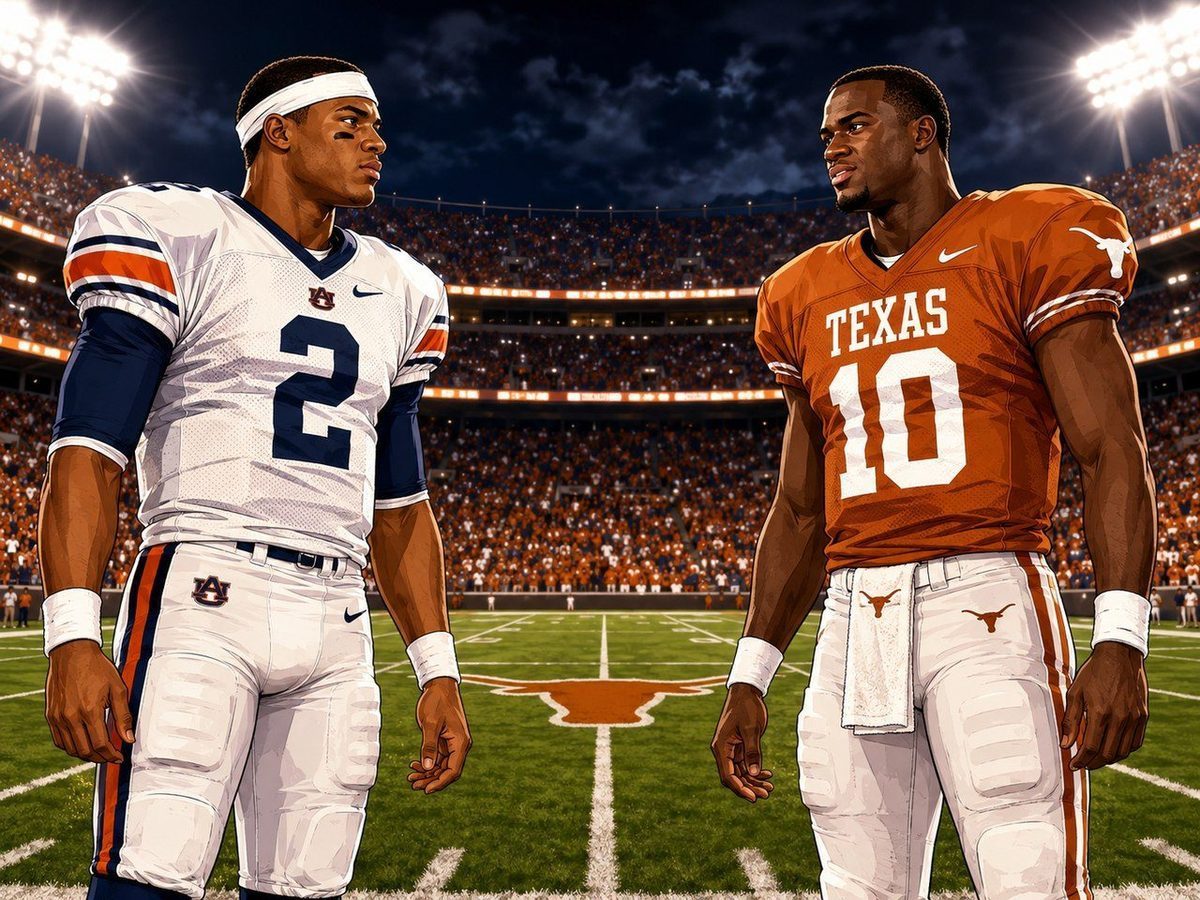
Yesterday afternoon, during the SEC Championship telecast, the highly biased announcers showed a statistical comparison between 2005 Vince Young and 2010 Cam Newton. The stat line appeared to favor Newton — precisely what CBS wanted you to think. CBS has billions invested in the SEC, and Verne Lundquist and Gary Danielson will do everything in their power to make you believe the conference is God’s gift to college football, that even its lowly bottom feeders would win any other league.
The Cam Newton–Vince Young debate isn’t nearly as laughable as most SEC/CBS propaganda, but it’s still humorous how clear-cut Gary Danielson made it out to be. First of all, the statistic was misleading: it failed to show that Vince Young played in just three fourth quarters during 2005, whereas Newton had played in all but two. Newton accumulated an additional 6 passing touchdowns and 2 rushing touchdowns in those fourth-quarter appearances. Vince Young had 1 passing touchdown at #4 Ohio State, and 2 rushing touchdowns against #1 Southern California in the national championship game.
What would Young’s numbers have looked like in 2005 had he been coached by someone known to run up the score? What if 2005 Texas had been coached by Urban Meyer or Bob Stoops? Vince Young probably would have added 1,000 passing yards, 5-10 more passing touchdowns, 500-plus rushing yards, and another 5-10 rushing scores.
Anyone who watched Vince Young play college football knew there were two Vince Youngs: regular Vince Young — who was still elite — and Big Game Vince Young. Cam Newton may be as good as, or even better than, regular Vince Young, but it remains to be seen whether he is as good as “Big Game” Vince Young.
Vince Young saved his best for big games, where his teammates relied on him 100%.
Young first showed what he could do against 2004 Michigan in the 2005 Rose Bowl. Young was absolutely unstoppable against the Wolverines, accounting for all five of Texas’ touchdowns — 180 yards passing and a touchdown, plus 192 rushing and four scores.
The following season, Vince Young picked up right where he left off when #2 Texas traveled to Columbus to face the #4 Ohio State Buckeyes. Texas found itself in serious trouble at the ‘Shoe deep into the fourth quarter, when Young marched the Horns down the field and flicked a perfect pass to the corner of the end zone to Limas Sweed for the go-ahead touchdown. That was the last time in 2005 that Texas and Vince Young were seriously threatened in the regular season. (Texas did trail big at halftime at Oklahoma State, but 35 unanswered points later, it wasn’t even close.)
Vince Young’s 2006 Rose Bowl performance will likely never be rivaled. Not by Cam Newton, and probably not by anyone. As good as Newton is, 2010 Oregon is nowhere near as good as 2005 Southern California.
It amuses me that Gary Danielson and CBS forget Young’s fourth-quarter comeback against USC. That clutch performance — leading his team past the two-time defending national champions, who had won 34 straight — is bar none the best in college football history. For Danielson and CBS to think pure black-and-white statistics beat actual performance is laughable. Then again, Danielson, Lundquist, and CBS have spent years trying to shove down our throats that Tim Tebow, and his gimmick one-yard touchdowns, is the best player in NCAA history.
So what could Cam Newton possibly do to top 2005 Vince Young? In my opinion, it’s nearly impossible — Newton isn’t facing a team of 2005 USC’s caliber. He has played a weaker schedule to this point, and has appeared in seven more fourth quarters than Vince Young did.
2005 Vince Young was more than numbers. He was an unstoppable machine who willed his team to victory and refused to lose. That is why Cam Newton will have a very difficult time rivaling what Vince Young did in 2005.